
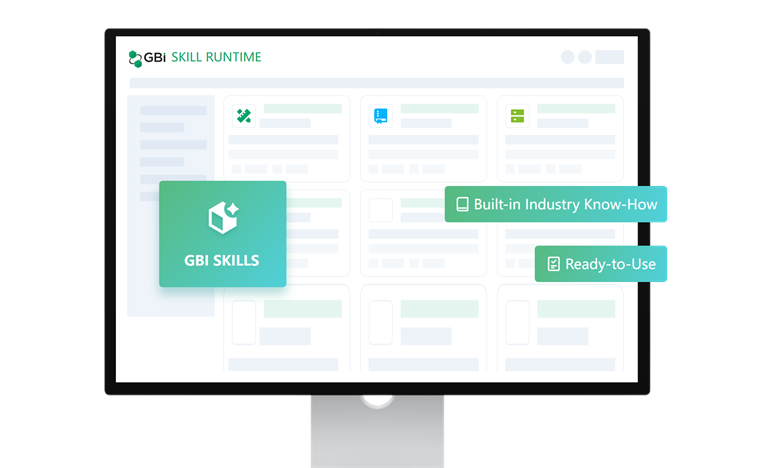

GBI Skills Library

An AI Skills Library Built on Pharmaceutical Industry Know-How

GBI Skills Library turns GBI’s pharmaceutical industry know-how into ready-to-use AI Skills for enterprise Agent systems. Covering scientific engagement and HCP management, disease and market insights, R&D and competitive intelligence, and market access and commercialization, it enables Agents not only to access data, but also to analyze it and execute business tasks using industry-specific methods.

Business Challenges

Challenge 1

Even with authoritative pharmaceutical data connected through MCP, general-purpose Agents may not know which databases to query, in what order, or which metrics to use to answer a specific business question. As a result, data is underused and analysis lacks depth.

Challenge 2

Model outputs often stop at raw data or high-level summaries, leaving a gap between AI-generated answers and the analysis, target lists, or recommendations required by business teams. Significant manual work is still needed to turn them into decision-ready deliverables.

Challenge 3

Many analytical tasks within enterprises are highly repetitive, from regular competitor monitoring to HCP profiling before visits. Although the data scope and analytical logic are largely fixed, teams still need to export and analyze the data anew each time, without a reusable, ready-to-run process. Repeating the same manual steps slows delivery and makes it difficult to maintain consistency across people and over time.

Solutions

GBI Skills adds the retrieval logic, analytical methods, and delivery standards that Agents need to perform industry-specific tasks. This moves Agents beyond simply accessing data toward completing real business workflows. Companies can use GBI’s prebuilt Skills, or work with GBI to develop custom Skills tailored to their workflows, data scope, and analytical standards, turning proven methods into reusable AI capabilities.

01.Built-in guidance for data retrieval

Each Skill includes detailed guidance on searching and querying GBI data and interpreting its fields: which databases to use, how to drill down step by step, which fields and metrics to retrieve, and what the results mean. Agents can automatically coordinate retrieval across multiple databases, making full use of connected authoritative data and providing a reliable foundation for further analysis.

02.Embedded industry methodologies

Each Skill incorporates the analytical framework and delivery standards for its use case: which dimensions to examine, how to segment and assess findings, and how to structure conclusions. Agents can therefore generate ready-to-use competitive landscape reports, tiered HCP lists, and market access recommendations, giving business teams actionable deliverables beyond raw data.

03.Custom Skills for your business workflows

Turn recurring analytical workflows into dedicated Skills tailored by GBI to your business scenarios, data scope, and analytical standards. Once configured, each workflow becomes a reusable, ready-to-run capability. Similar tasks can then follow the same predefined logic and output format without repeated instructions or tuning.

Skill Name

17 Skills

HCP Profile Analysis

Builds structured profiles from multidimensional HCP data, providing a comprehensive view of academic standing, expertise, and levels of influence to support precise identification and selection of target HCPs.

HCP Preference Analysis

Combines HCP publications, conference presentations, guideline contributions, clinical trials, and other data to characterize scientific interests, approaches to diagnosis and treatment, and professional priorities, informing targeted scientific engagement topics and strategies.

HCP Visit Recommendations

Combines HCPs’ latest scientific activity, upcoming conference schedules, collaboration networks, and historical visit records to generate personalized conversation starters and engagement recommendations, helping pharmaceutical representatives improve visit outcomes.

HCP Relationship Mapping

Maps target HCPs' collaboration networks through coauthorship, shared conference participation, and joint clinical trials. Identifies key influencers and pathways of academic influence to inform strategies for engaging HCP networks and extending reach.

Academic Conference Coverage Analysis

Analyzes attendance frequency, speaking roles, and specialty distribution across conferences for target HCP groups. Identifies high-value conferences with strong audience reach to optimize scientific event investment and budget allocation.

Identify HCPs Collaborating with Competitors

Systematically identifies HCPs with speaking, clinical, or scientific relationships with competitors. Quantifies the depth and breadth of competitors' scientific engagement to inform targeted competitive responses and strategies for strengthening scientific relationships.

Disease Research

Reviews the target disease's definition, classification, causes, pathogenesis, diagnostic criteria, and authoritative treatment standards. Produces a clearly structured, scientifically rigorous disease overview to support subsequent market and clinical analysis.

Epidemiology Analysis

Analyzes incidence, prevalence, mortality, geographic variation, and high-risk population characteristics. Incorporates epidemiological trends to support market sizing and estimates of the target patient population.

Treatment Landscape Analysis

Reviews current treatments, clinical efficacy, and the performance of drugs expected to enter the market for the target indication. Identifies unmet clinical needs and assesses potential market opportunities and entry windows.

Competitive Landscape Analysis

Analyzes market shares, competing development pipelines, and clinical efficacy advantages within the target segment, and forecasts the evolving competitive landscape. Produces visual competitive maps to support strategy, project selection, and regular competitor monitoring.

Clinical Efficacy Analysis

Uses authoritative sources, including scientific literature and clinical congresses, to quantitatively assess clinical performance across efficacy, safety, and other dimensions. Visual comparisons across patient populations and drugs provide a quantitative basis for clinical value assessment.

Target Intelligence

Tracks global development pipelines, progress by indication, major competitors, and the latest scientific findings for a specific target, revealing shifts in interest and R&D trends.

Company Profiles

Builds a comprehensive profile of a pharmaceutical company by analyzing its product pipeline, core R&D priorities, historical deals, key competitive challenges, financial performance, and long-term strategic direction.

Deal Intelligence

Tracks global pharmaceutical business development deals, investment, and financing in real time. Analyzes deal value trends, leading therapeutic areas, and deal flows to reveal transaction hotspots and industry capital movements.

Daily Pharmaceutical News

Automatically curates and interprets key global pharmaceutical news each day, covering policy, R&D, deals, approvals, and more. Delivers concise briefings proactively to keep teams informed of industry developments.

China Time-to-Approval Analysis

Analyzes the duration and historical patterns of each review stage, from submission to marketing approval in China, providing reliable reference data for forecasting new drug approval timelines.

Market Access Strategy Analysis

Combines data on national reimbursement negotiations, centralized procurement and tendering, and commercial insurance access to evaluate access strategies and pricing patterns, delivering practical recommendations for drug market access pathways in China.

See the Whole Landscape Shape What's Next in Pharma

GBI Health unites global pharmaceutical data, AI capabilities and industry expertise to deliver future-ready solutions across the entire product lifecycle.

Contact Us

